
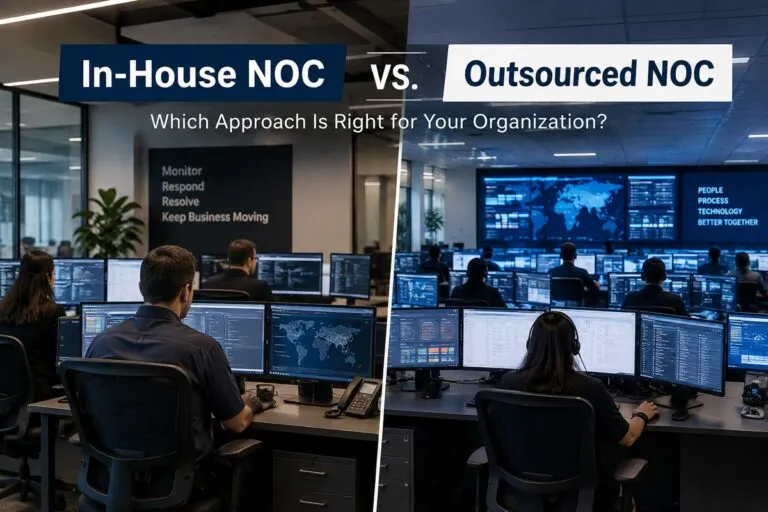
In-house NOC vs. outsourced NOC is an important decision for IT managers and corporate leaders responsible for network uptime, infrastructure performance, incident response, and operational costs. The right approach depends on the size and complexity of the IT environment, internal staffing capabilities, coverage requirements, geographic footprint, and how much direct control the organization needs over day-to-day network operations.
For organizations with distributed offices, data centers, warehouses, retail locations, branch networks, and other critical facilities, the decision becomes even more significant. A Network Operations Center must provide reliable monitoring and escalation while coordinating effectively with internal IT teams and on-site IT field services when physical intervention is required.
Comparing In-House NOC and Outsourced NOC Operations
An in-house NOC places network monitoring and operational responsibilities directly within the organization. Employees manage monitoring platforms, respond to alerts, troubleshoot incidents, escalate problems, maintain documentation, and coordinate with other internal IT teams.
An outsourced NOC shifts some or all of these responsibilities to an external NOC services provider. Depending on the service agreement, the provider may handle 24/7 network monitoring, alert management, initial troubleshooting, escalation, reporting, and coordination with remote hands or field technicians.
The difference is not simply where monitoring takes place. It affects staffing, technology investments, operating expenses, response procedures, scalability, and the amount of management required from internal IT leadership.
Staffing Requirements for an In-House NOC
Building an internal NOC requires more than assigning a few network administrators to watch alerts. Organizations seeking continuous NOC monitoring need enough personnel to cover multiple shifts while accounting for vacations, sick leave, training, turnover, and unexpected absences.
A 24/7 operation typically requires staffing across nights, weekends, and holidays. Additional personnel may also be necessary for escalation, management, engineering support, and specialized technologies.
Internal NOC staffing responsibilities can include:
- Network and infrastructure monitoring
- Alert validation and prioritization
- Incident troubleshooting
- Ticket creation and management
- Escalation to network engineers or other IT teams
- Vendor coordination
- Performance reporting
- Documentation and runbook maintenance
- Shift handoffs
- After-hours coverage
For large enterprises, maintaining this capability internally may make operational sense. For organizations that do not have enough monitoring volume to justify a fully staffed NOC, however, maintaining continuous coverage can create substantial overhead.
Outsourced NOC Services and Staffing Flexibility
An outsourced NOC allows an organization to use an established monitoring operation without building every component internally. The provider supplies the personnel, processes, monitoring capabilities, and shift coverage defined by the service agreement.
This can be particularly useful when an internal IT department operates primarily during normal business hours but the company’s infrastructure requires 24/7 NOC monitoring.
Instead of maintaining overnight and weekend shifts internally, an organization can use outsourced NOC services to provide continuous visibility and defined escalation procedures.
Outsourcing can also help organizations accommodate changing monitoring requirements. Adding locations, network devices, wireless infrastructure, servers, or other monitored systems may not require the company to immediately hire additional internal NOC personnel.
Cost Considerations for In-House vs. Outsourced NOC Services
Cost comparisons should account for the complete operating model rather than simply comparing employee salaries with a monthly NOC services contract.
An internal NOC may require expenses associated with personnel, benefits, overtime, recruiting, management, monitoring software, ticketing platforms, communications systems, workstations, training, and physical facilities.
Organizations should also consider less obvious costs, including employee turnover and the management time required to maintain round-the-clock operations.
An outsourced NOC generally converts many of these expenses into a more predictable operating cost. Pricing may be based on the number of devices, locations, services, endpoints, or another agreed-upon measurement.
However, outsourcing is not automatically less expensive in every environment. Very large enterprises with substantial monitoring requirements and existing network operations personnel may find that an internal NOC provides better economics at scale.
Evaluate Total NOC Operating Costs
When comparing the two approaches, IT leaders should consider costs such as:
- NOC analyst and engineer compensation
- Employee benefits and payroll expenses
- Overnight, weekend, and holiday coverage
- Recruiting and employee turnover
- Monitoring and management platforms
- Ticketing and communications systems
- NOC management
- Training and certifications
- Office or NOC facility expenses
- Provider onboarding and recurring service fees
Using total operating costs creates a more realistic comparison between in-house and outsourced NOC services.
24/7 Network Monitoring and After-Hours Coverage
Continuous coverage is one of the largest operational differences organizations should evaluate.
Network outages do not follow business hours. Internet circuits can fail overnight, switches can become unreachable during weekends, wireless controllers can experience problems during holidays, and infrastructure issues can occur when internal IT staffing is limited.
An in-house NOC can provide 24/7 monitoring, but only when the organization maintains sufficient staffing and processes to support it consistently.
An outsourced NOC provider can extend monitoring beyond normal internal IT hours. When properly structured, alerts are reviewed according to predefined priorities and escalated to designated internal contacts when necessary.
For IT leaders evaluating outsourced NOC monitoring, the important question is not simply whether monitoring is available 24/7. They should determine exactly what happens when an alert is received at 2:00 a.m.
Incident Response and Escalation Procedures
Monitoring has limited value without an effective response process.
Both in-house and outsourced NOC models need clearly documented procedures defining how alerts are categorized, investigated, escalated, documented, and resolved.
An internal NOC may have an advantage when incidents require extensive knowledge of proprietary applications, unusual infrastructure configurations, or internal business processes. Employees who work with the environment every day may already understand dependencies that an external provider needs documented.
An outsourced NOC can compensate for this through detailed runbooks, escalation matrices, network documentation, contact lists, and defined operating procedures.
Questions to Address Before Outsourcing NOC Monitoring
Organizations considering an outsourced NOC should establish answers to questions such as:
- Which devices and systems will be monitored?
- Which alerts require immediate investigation?
- What constitutes a critical incident?
- Who should be contacted after hours?
- How quickly should different alert priorities be acknowledged?
- What troubleshooting can the NOC perform without approval?
- When should incidents be escalated to internal IT?
- When should carriers or technology vendors be contacted?
- How will tickets and incident notes be documented?
- What reports will IT leadership receive?
Clear answers reduce ambiguity and help outsourced NOC services operate as an extension of the internal IT organization.
Control and Visibility
Organizations sometimes assume outsourcing a NOC means giving up visibility into network operations. The actual level of control depends heavily on how the service is structured.
An internal NOC naturally provides direct managerial control over employees, processes, monitoring platforms, and operational priorities. Changes can often be implemented internally without renegotiating a service agreement.
An outsourced NOC introduces another organization into the operational process. IT leaders therefore need clearly defined access, reporting, escalation, communication, and governance procedures.
Organizations should understand who owns monitoring configurations, who can change thresholds, where incident records are maintained, what dashboards are available, and how performance is reported.
The goal should be to maintain operational visibility even when monitoring responsibilities are handled externally.
Scalability Across Multiple Locations
NOC requirements can become more complicated as organizations expand geographically.
A company managing five locations has different requirements from an enterprise responsible for hundreds of offices, warehouses, stores, healthcare facilities, manufacturing sites, or branch locations.
With an internal NOC, growth can mean additional devices, alerts, circuits, tickets, and staffing requirements. IT leadership must determine whether the existing team can absorb the additional workload or whether more NOC personnel are required.
An outsourced NOC may provide additional flexibility for multi-site IT environments because monitoring capacity can often be expanded without building new internal shifts or immediately recruiting additional employees.
This can make outsourced NOC monitoring particularly relevant to organizations completing acquisitions, opening locations, consolidating facilities, or performing large-scale multi-site IT rollouts.
When Network Problems Require Someone On-Site
Neither an in-house nor outsourced NOC eliminates the need for physical IT support.
Many network incidents can be investigated remotely, but some require a technician at the affected location. A switch may need to be physically inspected, a failed device may require replacement, cables may need to be traced, equipment may need to be rebooted manually, or a carrier may require someone on-site for circuit troubleshooting.
This becomes particularly important for organizations with locations where no dedicated IT employees are present.
Combining NOC monitoring with nationwide IT field services, remote hands, and smart hands services can help close this operational gap. The NOC identifies and investigates the problem remotely, while a qualified field technician handles the physical work at the affected facility when necessary.
For geographically distributed organizations, coordination between NOC personnel and on-site IT technicians can reduce the amount of troubleshooting expected from office managers, facilities personnel, or other non-technical employees.
In-House NOC Advantages and Operational Tradeoffs
An in-house NOC can provide a high degree of control and organizational familiarity. Internal employees can develop detailed knowledge of network architecture, business applications, locations, users, and company-specific operating procedures.
Organizations may benefit from:
- Direct management of NOC personnel
- Deep familiarity with internal systems
- Immediate access to internal engineering teams
- Greater control over monitoring tools and processes
- Easier integration with highly customized internal workflows
Those benefits come with operational responsibilities. The organization must recruit, retain, schedule, manage, and develop enough personnel to maintain the required coverage.
This approach is generally easier to justify when network operations represent a large, consistent workload that requires dedicated internal resources.
Outsourced NOC Advantages and Operational Tradeoffs
Outsourced NOC services can reduce the internal resources required to maintain continuous network monitoring. Organizations gain access to an established monitoring operation without having to independently staff every shift.
Potential advantages include:
- 24/7 NOC monitoring without building an internal overnight team
- More predictable operational costs
- Reduced internal staffing requirements
- Faster expansion of monitoring coverage
- Support for distributed and multi-site networks
- Defined alert handling and escalation procedures
- Additional operational coverage during weekends and holidays
The primary tradeoff is that successful outsourcing depends heavily on documentation, communication, and service design.
A provider cannot automatically know which systems are most important to the business or how every alert should be handled. Those expectations need to be established during onboarding and maintained as the environment changes.
Service Level Agreements Matter in an Outsourced NOC
The service level agreement should clearly define the operational expectations between the organization and its NOC provider.
IT leaders should examine more than a general uptime or availability statement. The agreement should address monitoring coverage, alert acknowledgement, escalation procedures, communication methods, reporting, and responsibilities.
It is also important to distinguish between an alert acknowledgement time and an incident resolution time. A NOC may quickly acknowledge an alert while the underlying problem still requires an ISP, hardware vendor, internal engineer, or on-site technician to resolve it.
Clearly defined responsibilities help prevent misunderstandings during high-priority network incidents.
Hybrid NOC Models Can Preserve Internal Control
The in-house NOC vs. outsourced NOC decision does not always require moving completely to one model.
Some organizations maintain internal network engineers and IT operations personnel while outsourcing specific monitoring responsibilities. For example, an outsourced NOC can handle Level 1 monitoring, alert validation, ticket creation, and after-hours escalation while internal engineers retain responsibility for advanced troubleshooting and infrastructure changes.
A hybrid NOC model can also provide after-hours monitoring while internal IT handles network operations during normal business hours.
This structure can be useful when an organization wants to retain technical knowledge and decision-making internally without maintaining a fully staffed 24/7 NOC.
Choosing the Right NOC Model for a Distributed IT Environment
IT managers evaluating in-house NOC vs. outsourced NOC should base the decision on operational requirements rather than monitoring alone.
Consider the number of locations and devices being monitored, the business impact of outages, required coverage hours, current IT staffing levels, escalation requirements, geographic distribution, and access to on-site IT support.
Organizations should also evaluate how frequently incidents require physical intervention. A nationwide network may be monitored from one centralized location, but network equipment still exists at individual facilities.
A strong operating model connects network monitoring, internal IT teams, technology vendors, carriers, and IT field services so incidents can move efficiently from detection to resolution.
For organizations with a large internal infrastructure team and highly specialized environments, maintaining an in-house NOC may provide the desired level of direct operational control. Organizations that need broader coverage without expanding internal staffing may use outsourced NOC services to extend their existing IT operations. Hybrid models can divide responsibilities between the two.
The most effective approach is the one that establishes clear monitoring responsibilities, reliable 24/7 coverage where required, documented escalation procedures, measurable service expectations, and a practical way to dispatch on-site IT support when remote troubleshooting reaches its limit.